
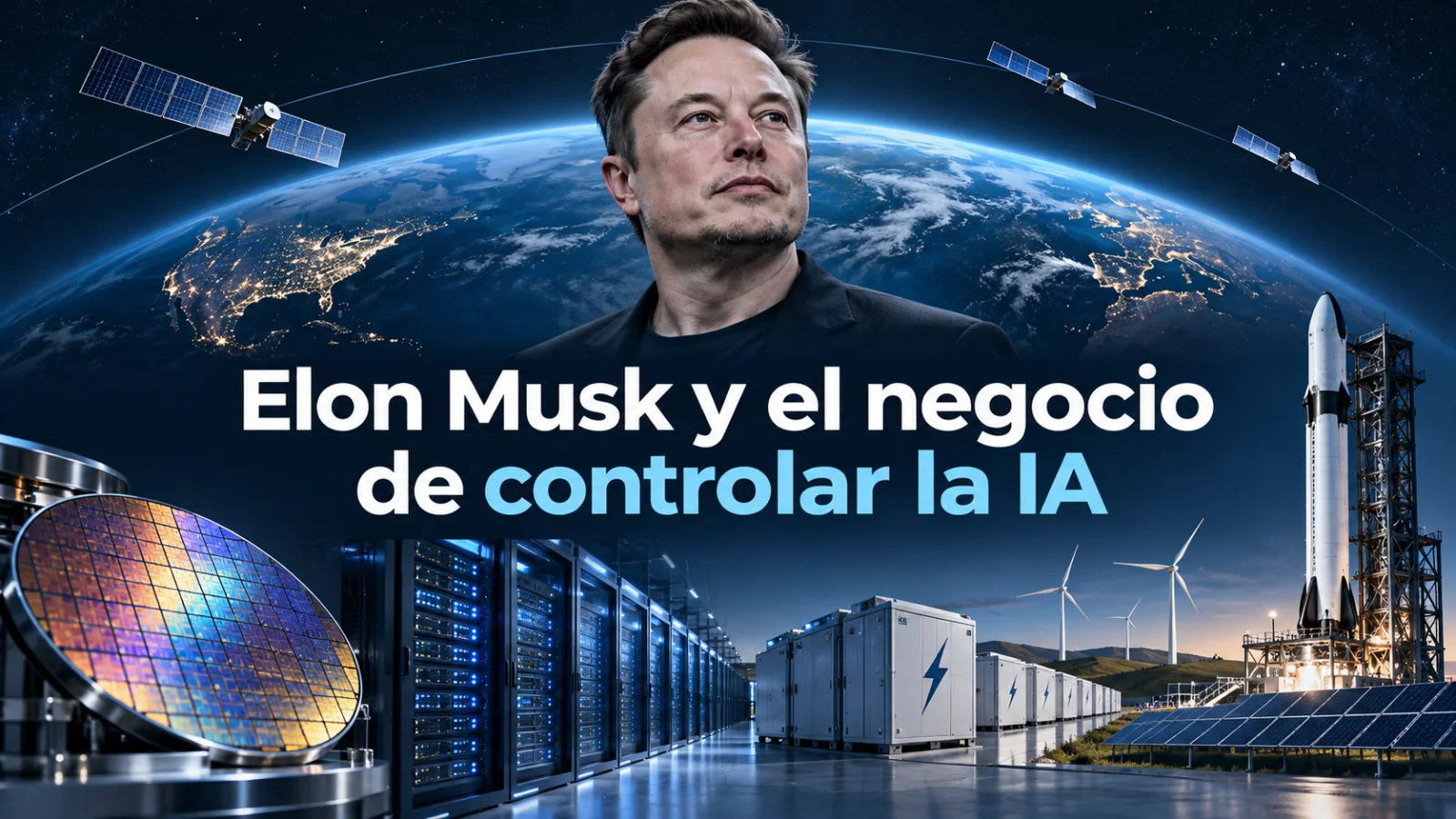
The other artificial intelligence race
Much of the conversation about artificial intelligence focuses on which model produces better answers, which is faster, which writes more accurate code or which performs best on benchmarks.
It is a reasonable comparison, but an incomplete one.
Behind every answer generated by ChatGPT, Gemini, Claude or Grok is a physical infrastructure consisting of processors, data centers, cooling systems, communications networks and energy supplies. These resources require substantial investment, and their availability can determine how far a technology company is able to grow.
From this perspective, Elon Musk's business strategy takes on another dimension.
Grok does not need to remain the world's most advanced AI model to become an important part of his business. If the companies associated with Musk succeed in controlling a significant share of the resources the industry needs, they could generate revenue even from companies that compete directly with his AI products.
What we may be witnessing is something broader than a strategy designed to win every technology race. It is an opportunity to participate economically in several of them, regardless of who wins.
From independent companies to a business ecosystem
For years, SpaceX, Tesla, Starlink and other Musk initiatives appeared to address different markets and needs.
SpaceX developed aerospace technology. Tesla advanced electric mobility and energy storage. Starlink deployed a satellite telecommunications network. Twitter, subsequently renamed X, operated as a digital communications platform.
The emergence of xAI in 2023 introduced an element capable of connecting several of these capabilities: artificial intelligence.
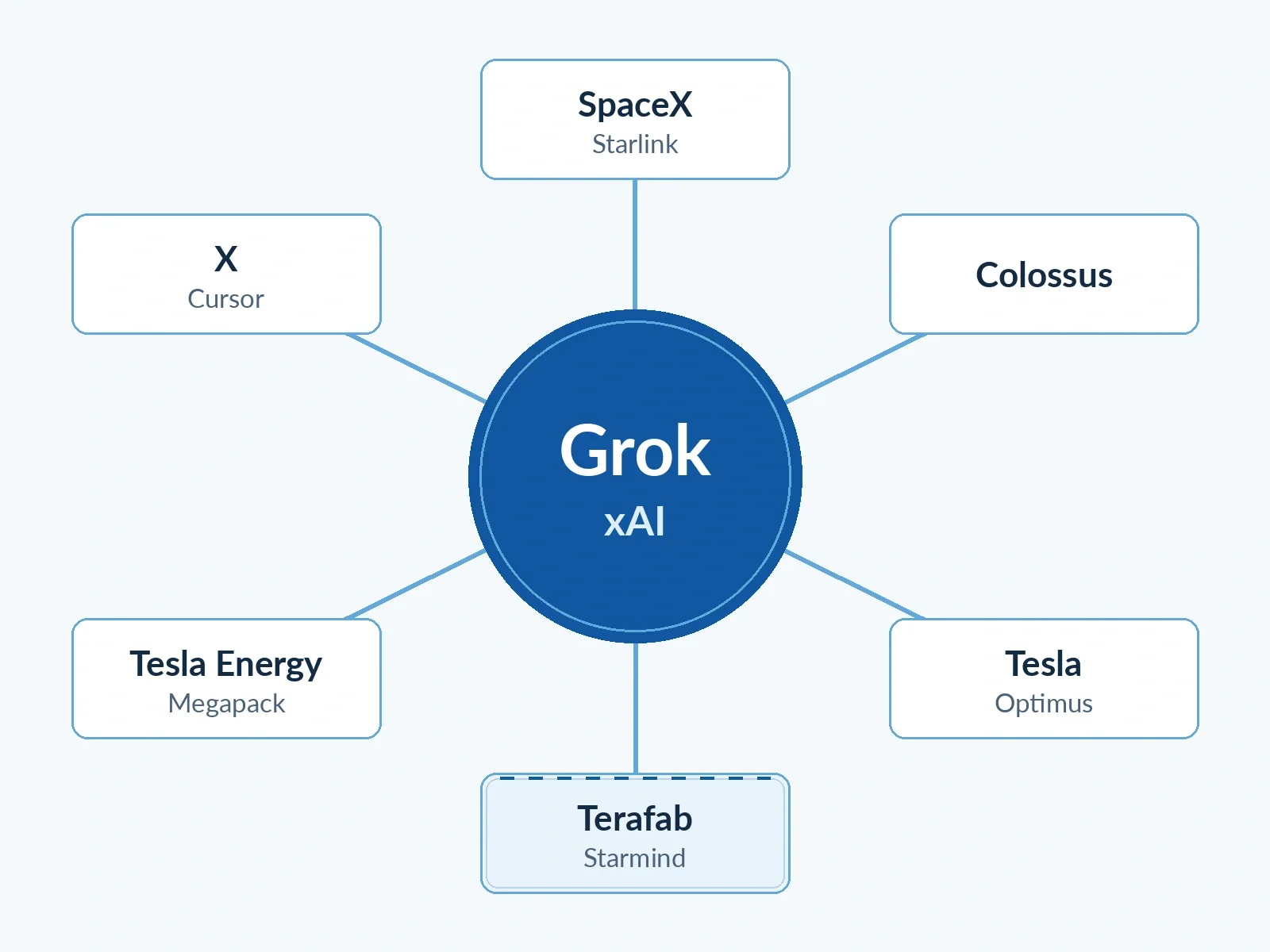
In March 2025, xAI acquired X. On February 2, 2026, SpaceX completed its acquisition of xAI. In August of the same year, it acquired Cursor, an AI-assisted software development platform, through a transaction based on an implied equity value of $60 billion.
These transactions represent documented corporate integration rather than merely a connection between companies associated with the same entrepreneur.
Tesla remains a separate company. However, its board has established a special committee to explore a deeper relationship with SpaceX, including a potential business combination. As of this article's research cutoff, no such transaction has been confirmed.
It would be tempting to interpret Musk's entire business history as the execution of a plan conceived decades ago. There is insufficient evidence to support that claim. What we can observe is a convergence of assets that originally addressed different needs and now offer opportunities to complement one another.
When your competitor is also your customer
In May 2026, Anthropic, the company behind Claude, announced an agreement to use the computing capacity of Colossus 1, a SpaceX data center.
According to Anthropic, the agreement provided access to more than 300 megawatts of capacity and an infrastructure equipped with over 220,000 Nvidia graphics processing units.
The strategic significance of this agreement extends beyond its technological scale. Claude competes with Grok in the generative AI market, yet its developer also purchases infrastructure services from the business group behind Grok.
This is an example of coopetition: companies competing in certain activities while collaborating commercially in others.
In 1986, economist David J. Teece explained that the financial benefits of innovation do not always accrue to those who develop it. Under certain circumstances, companies controlling the complementary assets required to commercialize an innovation can capture a substantial share of its value.
Manufacturing, distribution, customer access and infrastructure are examples of such assets.
Applied to artificial intelligence, this framework helps explain why developing the best model may not be sufficient to achieve economic dominance.
Anthropic, of course, also has agreements with other providers. Its relationship with SpaceX does not establish exclusive dependence, but it does illustrate how a company can benefit from a competitor's growth.
Chips: a dependency Musk has yet to resolve
The Colossus infrastructure provides computing capacity, but essential components still come from external manufacturers.
Nvidia, TSMC and other participants in the semiconductor supply chain perform specialized functions that cannot easily be replaced.
In March 2026, SpaceX and Tesla announced Terafab, an initiative aimed at integrating logic chip manufacturing, memory production and advanced packaging. Intel subsequently joined the project.
The business rationale is understandable. If a company needs large numbers of processors to train models, operate autonomous vehicles, develop robots and deploy space infrastructure, its own manufacturing capacity could reduce some supply constraints.
It could also enable components to be designed around specific applications.
Advanced semiconductor manufacturing, however, requires specialized equipment, accumulated expertise, materials, intellectual property and highly complex industrial processes. Terafab does not represent technological independence already achieved.
It is an investment in reducing future dependencies, whose success must still be demonstrated through actual production, quality, costs and manufacturing capacity at scale.
Energy: the physical resource behind every answer
Artificial intelligence feels intangible when we use it on a computer or mobile phone. Its operation, however, depends directly on physical resources.
According to updated 2026 projections from the International Energy Agency, global data center electricity consumption could increase from 485 terawatt-hours in 2025 to 950 in 2030.
These figures include conventional data centers as well as those optimized for AI. The 2030 figure is a projection rather than observed consumption.
The importance of securing electricity supplies helps explain the role of Tesla Energy within this ecosystem.
Tesla markets industrial energy storage systems such as Megapack, which can contribute to electricity demand management and grid stability.
During the first nine months of 2026, Tesla recognized $626 million in revenue from Megapack sales to SpaceX, according to its financial disclosures.
Here we find another example of complementary business capabilities already generating economic activity.
It is worth remembering that batteries store electricity rather than generate it. The ecosystem still depends on sources of power generation and cannot be considered energy self-sufficient.
The IEA's central projection indicates that global data center electricity consumption could nearly double between 2025 and 2030. It includes conventional and AI-focused data centers. 2025: historical estimate; 2030: central projection.
Unit: TWh
- Electricity consumption
| Category | Electricity consumption (TWh) |
|---|---|
| 1. 2025 · Estimate | 485 |
| 2. 2030 · Projection | 950 |
Data and artificial intelligence in the physical world
X provides an environment for distribution and access to digital information. Cursor connects artificial intelligence with software development. Tesla develops technologies related to perception and driving, while Optimus aims to extend automation into physical work through humanoid robots.
Each of these activities may generate learning and capabilities relevant to other technologies.
Not all data, however, are interchangeable. Textual information from a social network serves a different purpose from vehicle sensor records or robot movements.
Companies are also not automatically entitled to share data simply because they have common shareholders or executives.
Privacy, security, user rights and intellectual property must be considered when designing any technology ecosystem.
Similar caution applies to Neuralink. Although brain-computer interface research conceptually fits a broader vision of connecting digital systems with human capabilities, there is insufficient evidence to claim that its clinical data are being used to train Grok on a widespread basis.
Potential complementarity should not be confused with actual integration.
Why move data centers into space?
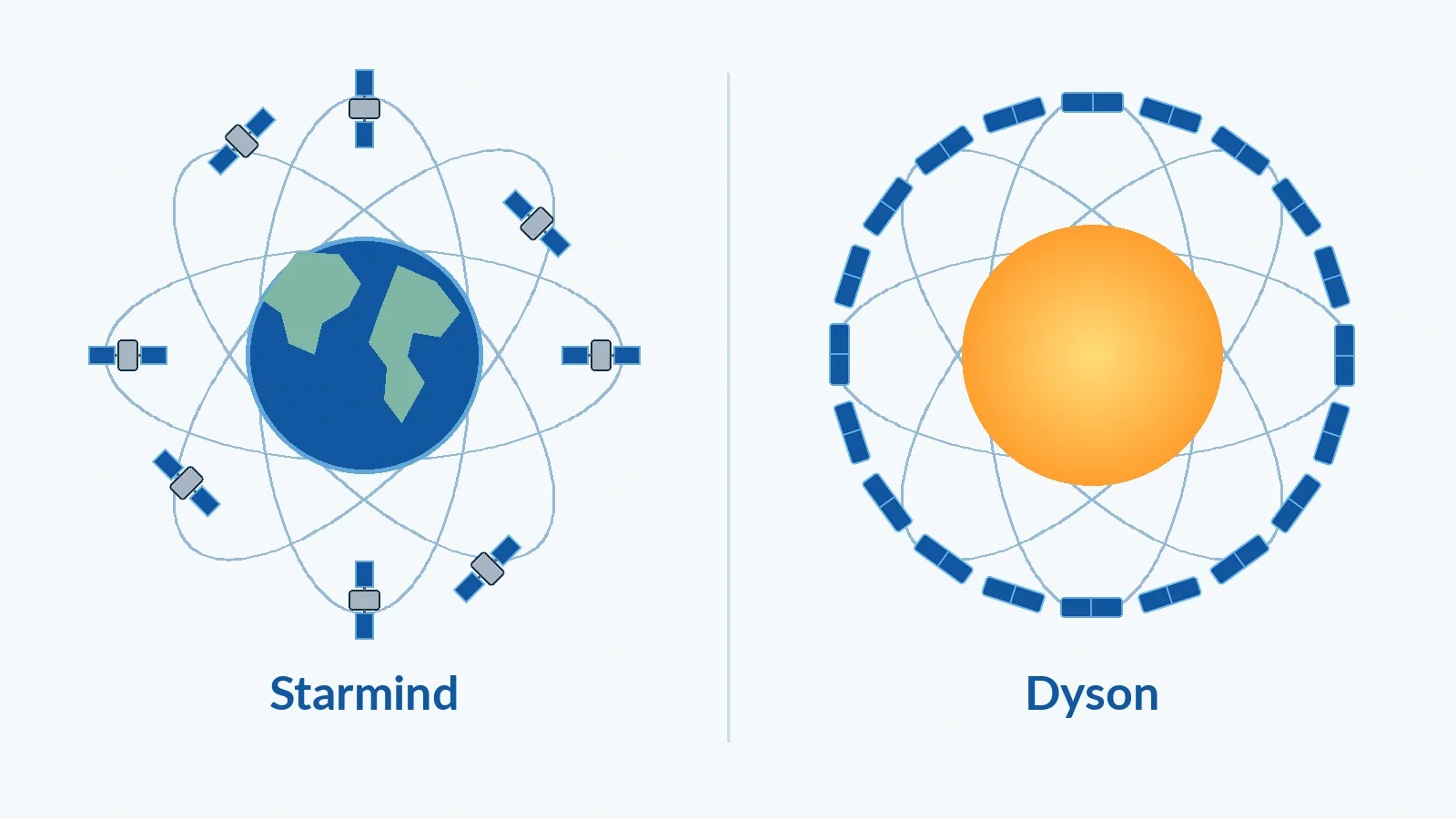
On November 25, 2026, the US Federal Communications Commission granted partial and conditional authorization for Starmind, a SpaceX project involving a proposed constellation of up to one million satellites designed for orbital computing.
The concept involves moving some computing workloads into space, using solar radiation to generate electricity and communicating results with systems on Earth.
Through Starlink and its launch vehicles, SpaceX has developed experience in satellite manufacturing and deployment. This gives the company a relevant position from which to investigate orbital computing.
But deploying a telecommunications network is not equivalent to operating AI infrastructure on such a scale.
Cooling, for example, presents a major challenge. Although space is associated with cold temperatures, the vacuum prevents heat dissipation through convection into the external environment. Equipment must transfer thermal energy to radiating surfaces capable of emitting it.
Other challenges include radiation exposure, maintenance, processor obsolescence, inter-satellite communication and orbital debris.
Google is also exploring this possibility through Project Suncatcher. In October 2026, it reported receiving an initial response from a model running on one of its TPU processors in orbit.
This is an interesting experimental milestone, but it does not yet demonstrate that space-based data centers can compete economically with terrestrial facilities.
Playing connects to the provider, which may use cookies.
Introduction to Project Suncatcher, Google's initiative exploring solar-powered AI processors in space.
From Starmind to a Dyson swarm
In 1960, physicist Freeman Dyson published a paper in Science exploring the possibility of detecting advanced civilizations through infrared radiation associated with their use of stellar energy.
This proposal gave rise to the concept popularly known as a Dyson sphere.
One interpretation involves a swarm of independent collectors orbiting a star to capture part of its energy.
SpaceX has explicitly linked its orbital computing project with the aspiration of progressing toward a Type II civilization on the Kardashev scale, a hypothetical classification based on the ability to harness energy.
There is, therefore, a conceptual connection between these ideas.
Starmind, however, involves systems orbiting Earth rather than a structure surrounding the Sun. The technological, industrial and energetic distance between an Earth-orbiting constellation and a Dyson swarm is extraordinary.
Manufacturing satellites on the Moon, another element of SpaceX's business vision, remains a prospective ambition.
What matters here is understanding that Musk appears to regard the availability of energy and computing capacity as potential constraints on long-term technological development.
Recognizing the scale of that ambition does not require accepting its realization as inevitable.
An ambitious strategy does not guarantee a profitable business
Financial results allow us to compare part of the narrative with business reality.
In the third quarter of 2026, SpaceX reported total revenue of $14.575 billion. Of this amount, $7.560 billion came from its artificial intelligence and related activities segment, known as Super Intelligence.
The segment reported quarterly operating income of $431 million, while accumulating operating losses of $3.295 billion over the first nine months of the year.
Its third-quarter capital expenditure amounted to $16.444 billion.
These figures illustrate both the commercial potential of the market and the substantial investment required to compete in it.
Furthermore, Google, Amazon and Microsoft are developing their own technology ecosystems, combining processors, cloud services, artificial intelligence models and distribution channels.
Competition has not disappeared. Nor can we conclude that all these companies will eventually become dependent on Musk.
Business integration can create economies of scale and competitive advantages, but it can also increase organizational complexity, concentration of power and shared exposure to financial or technological risks.
Selected quarters, not a complete quarterly series. Capital expenditure is not equivalent to operating losses. Figures reported by SpaceX for the Super Intelligence segment in its Q3 2026 results.
Unit: USD million
- Revenue
- Capital expenditure
| Category | Revenue (USD million) | Capital expenditure (USD million) |
|---|---|---|
| 1. Q3 2025 | 813 | 4760 |
| 2. Q2 2026 | 2561 | 15828 |
| 3. Q3 2026 | 7560 | 16444 |
What small businesses can learn from this strategy
The practical lesson is not to try to build a company that does absolutely everything.
Small and medium-sized businesses need to identify the resources that determine their ability to create value and the dependencies that could restrict their growth.
Consider a tourism business that receives most of its bookings through third-party platforms. It may offer an excellent service and still depend on commissions, contractual conditions and algorithms controlled by intermediaries.
Developing its own customer acquisition channels, managing customer data responsibly and facilitating direct bookings could give it greater autonomy.
It does not need to build a global tourism platform. It needs greater control over the assets that are strategically important to its business.
The same principle applies to artificial intelligence. Before subscribing to a tool or automating a process, businesses should consider what problem it solves, how much it costs to maintain, what data it requires, how it integrates with existing systems and what would happen if they needed to change providers.
Business autonomy does not mean rejecting partnerships. Working with external specialists is often more efficient than trying to develop every capability internally.
Original conceptual framework for identifying critical dependencies and deciding what to control, share or outsource; it does not represent experimental results.
| Strategic asset | Business question | Application |
|---|---|---|
| Data | Who controls my business information? | CRM and first-party data |
| Distribution | Do I depend on intermediaries? | Direct acquisition channels |
| Technology | Can I switch providers? | Portability and interoperability |
| Processes | Which capabilities differentiate my business? | Selective in-house development |
| Partnerships | What is more efficient to outsource? | Specialized providers |
A final reflection
We do not know whether Elon Musk will succeed in building the technology ecosystem that appears to be taking shape. Nor do we know whether orbital data centers will become competitive, whether Terafab will achieve its industrial objectives or whether Grok will establish a dominant market position.
What we can observe is a strategy that extends beyond the development of a single product.
The next major artificial intelligence race may be determined not exclusively by model quality, but also by the ability to control the resources that allow those models to operate.
And that reflection applies to businesses of every size. Before asking ourselves how to offer a better product, perhaps we should understand who controls the conditions that allow us to compete.
Audiovisual references
- Google. Google’s latest moonshot to put machine learning in space. YouTube.
Sources & references
- Space Exploration Technologies Corp. — Form 10-Q, quarter ended September 30, 2026 · SEC
- SpaceX — Third Quarter 2026 Results · SEC
- Tesla, Inc. — Form 10-Q, quarter ended September 30, 2026 · SEC
- Higher usage limits and a SpaceX compute deal · Anthropic
- Teece, D. J. (1986). Profiting from technological innovation: Implications for integration, collaboration, licensing and public policy · Research Policy
- Space Exploration Technologies Corp. — Prospectus, Form 424B4 · SEC · 2026-06-11
- Key Questions on Energy and AI — Executive summary · International Energy Agency
- Memorandum Opinion and Order and Authorization — DA 26-1273 · Federal Communications Commission · 2026-11-25
- Small Spacecraft Technology State of the Art — 7.0 Thermal Control · NASA
- Beals, T. — We’ve received our first response from the Project Suncatcher prototype satellite. · Google Research · 2026-10-30
- Dyson, F. J. — Search for Artificial Stellar Sources of Infrared Radiation · Science · 1960-06-03
- xAI joins SpaceX to Accelerate Humanity’s Future · SpaceX
- Competition in artificial intelligence infrastructure — Executive summary · OECD
Comments (0)
Add context, a question or a perspective. Comments are moderated when needed and email is required so we can let you know when your participation has been received or replied to.
Join the conversation
Your email stays private. We use it to confirm your comment and notify you if Alejandro replies.
A question, an observation or a perspective can open a valuable conversation.