
A company challenging what a robot should look like
When we picture an intelligent robot, we often imagine a figure with a head, arms, torso and legs. Popular culture has reinforced that image for decades. But a machine capable of carrying out human tasks does not necessarily need to reproduce our entire anatomy.
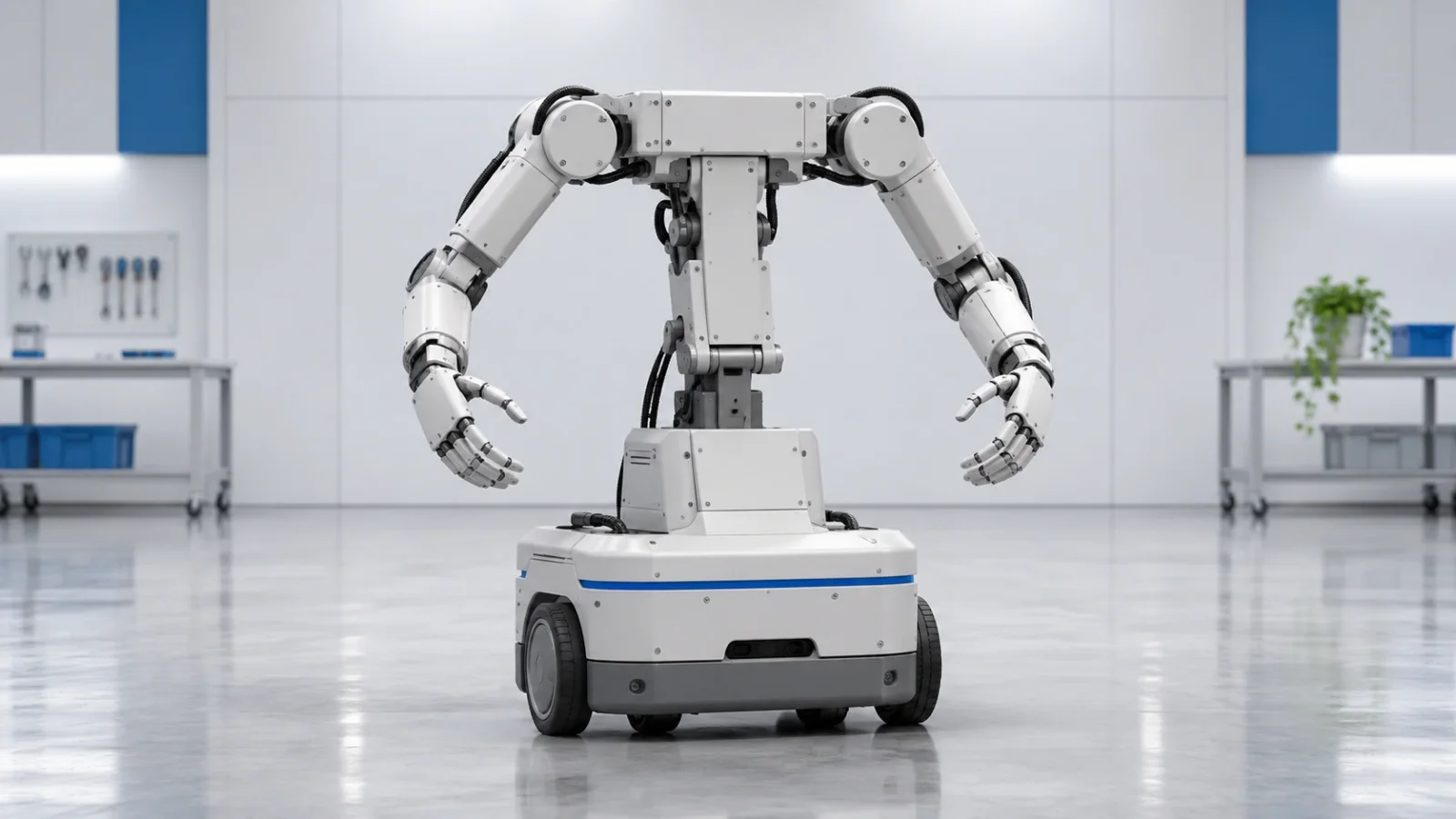
On November 17, 2026, Genesis AI announced a $500 million Series A at a post-money valuation of $3.5 billion. Its first general-purpose robot, Eno, unveiled in June, deliberately departs from the conventional bipedal humanoid: it has a wheeled base, two arms, humanlike hands and an articulated structure that can fold down. It has neither a face nor a conventional head.
What interests me about this story is a question that goes beyond robotics. When we design a product, are we solving a real problem or reproducing the features we have learned to associate with its category? The distinction can shape development costs, how the product is used and the value it delivers to customers.
From scientific research to a startup
Genesis AI co-founders Zhou Xian and Théophile Gervet share a background in robot learning research. In May 2023, together with four other authors, they published Towards Generalist Robots: A Promising Paradigm via Generative Simulation on arXiv. It was a position paper proposing the large-scale generation of scenarios, tasks and training signals to develop reusable skills. It did not establish that a robot capable of solving any task already existed.
On July 1, 2025, Genesis AI emerged from stealth and announced $105 million in seed funding, co-led by Eclipse and Khosla Ventures. In November 2026, it announced its new round, co-led by Premji Invest, Khosla Ventures and Eclipse, with investors including NVIDIA and Bpifrance. The two announced rounds total $605 million.
The company, with a presence in France and California, sits at the intersection of research, engineering and venture capital. Funding makes it possible to pursue projects requiring infrastructure, data and highly specialised professionals. But funding is not revenue. A private valuation expresses the value assigned to the company in an investment transaction; it does not indicate its sales, profits or available cash. Investors are taking a risk on the future capabilities of a business that has yet to establish itself commercially.
Why general-purpose robots are difficult to build
Industrial automation has been solving physical tasks for decades. A specialised arm can pick components from a production line with remarkable precision and repeatability. The challenge changes when those components vary in size, arrive in unexpected positions or must be handled with different tools.
General-purpose robotics seeks to address a range of activities without rebuilding the entire solution for each task. It does not mean that a robot can do anything. It means that its architecture is intended to support some transfer of skills between situations, within limits that must be established experimentally.
Physical AI introduces a further challenge: software decisions become real movements. If a machine attempts to pick up a glass, it must determine its position, control the hand's trajectory, manage contact and adjust its grip to prevent slipping or breakage. A small change in material or surface can alter the outcome. An error is not confined to an incorrect answer on a screen; it can damage an object or endanger somebody working nearby.
Genesis AI is pursuing an integrated approach that combines its GENE artificial intelligence model, mechanical design, data collection and physics simulation. In May 2026, the company introduced GENE-26.5, a version of its robot learning model. Its strategy includes sensor-equipped gloves to record movements performed by people and relate them to the movements of its robotic hands. The aim is to use human actions as training data.
The Genesis World platform enables skills to be developed and evaluated in virtual scenarios. Simulation makes it easier to explore variations without physically testing every one. Even so, transferring what a robot learns into the real world remains difficult: friction, wear and irregularities in materials cannot always be reproduced accurately. Integrating these technologies is an approach to addressing the problem, not proof that the problem has been solved.
Wheels, hands and a design decision
Eno's approach is interesting because it retains some human characteristics while dispensing with others. Hands are important for interacting with objects and tools designed for us. In contrast, reproducing human walking is not necessarily a priority in many industrial facilities with flat surfaces.
A wheeled base can reduce the complexity associated with dynamic balance and bipedal locomotion in those spaces. Eno's adjustable structure is intended to provide access to different heights and reduce its footprint when idle. A legged robot, however, may be better suited to climbing stairs, negotiating obstacles or crossing certain kinds of terrain. The merits of an architecture depend on the task, environment and total cost of operation.
The decision also has implications for branding. In a market where many projects are presented as humanoid figures, Eno's appearance may help distinguish Genesis's proposition. Visual differentiation, however, does not guarantee recall, preference or purchase intention. Demonstrating those effects would require research into how the product is perceived and recognised by its relevant audiences.
What we expect from a humanlike machine
Anthropomorphism is the tendency to attribute human characteristics to entities that are not human. It can arise when we see a face, hear a voice or interpret a movement as intentional. In technology, it may lead people to attribute social or cognitive abilities to a machine that it does not necessarily possess.
A meta-analysis published in 2021 by Markus Blut, Cheng Wang, Nancy V. Wünderlich and Christian Brock in the Journal of the Academy of Marketing Science combined data from 11,053 individuals across 108 independent samples in studies of service robots, chatbots and other AI systems. The findings associate perceived anthropomorphism with different consumer responses but indicate that the relationship depends on the type of technology and service. Perceived usefulness and other functional characteristics are relevant to understanding people's intention to use these systems.
The research does not establish that adding human features to a robot always increases trust. Nor was it conducted specifically with Eno, so it cannot establish acceptance among industrial workers. It provides a basis for asking questions, not proof of the psychological superiority of Eno's design.
In a factory, knowing where a robot is about to move and how to stop it may matter more than seeing a facial expression. Genesis has announced a version with an information display. This could help people understand its operating state, although its effectiveness would need to be tested with real users. The interface is not a substitute for safety systems, nor does it guarantee that an explanation faithfully represents the AI's internal processes.
From an experience design perspective, I consider it more useful to aim for trust calibrated to the technology's actual capabilities than to maximise the feeling of trust. Both excessive trust and unjustified distrust can interfere with appropriate use.
The gap between a demonstration and a viable business
In June 2026, Genesis announced a partnership with LG CNS to evaluate industrial applications in manufacturing and logistics, initially in the United States. The partnership may help identify tasks, integrate the technology and assess its performance in real operations. It does not, in itself, establish large-scale sales or contracts worth a specified amount.
A TechCrunch report dated November 17 provides an important counterpoint: Genesis reported building 30 to 40 Eno units, and the outlet noted that its hands needed replacing after a few weeks of regular work. These figures come from information supplied to or reported by the outlet, not an independent durability trial. Reuters confirmed the funding round and reported that part of the capital would be used to expand production and improve manipulation capabilities.
There is a considerable gap between performing an action correctly in a demonstration and maintaining that performance for months at a competitive cost. An industrial customer needs to know failure rates, repair times, spare parts availability, safety and actual productivity. As of the review date, I do not have sufficient public information to verify Eno's price, realised sales, Genesis's profitability or reliability over extended working periods.
The company plans to start with manufacturing, logistics and laboratories before addressing other sectors. This is an expansion plan, not evidence that the robot can already operate autonomously in hospitals, hotels or homes. Beyond technical requirements, deployment must consider occupational risks, data protection, physical safety and the obligations applicable to each environment. Automation should be assessed in terms of its effects on people, not just potential cost reductions.
What small businesses can learn from this story
A business does not need to build a robot to apply the lesson from Genesis. Consider a hypothetical small cosmetics manufacturer looking to reduce errors when preparing orders. Before investing in advanced robotics, it should observe the process, identify where errors occur and determine whether the cause lies in product identification, warehouse organisation or physical handling. A barcode scanner, a revised layout or specialised automation might solve the problem more effectively.
If robotics is a reasonable alternative, I would recommend a tightly scoped pilot. I would measure time per order, errors, equipment availability and the human interventions required, comparing the results with the existing process. I would include the costs of integration, training, maintenance, replacement components and downtime. Hours of labour freed up only represent an economic benefit if they can be translated into actual savings, usable additional capacity or another measurable improvement.
The same principle applies to a website, booking system, AI assistant or new brand identity. Investigating what users need and how they behave in real situations helps distinguish useful features from design conventions. The next step is to test whether the proposed solution improves both the experience and business outcomes, rather than assuming that technological novelty delivers value.
Innovation also means deciding what not to build
The Genesis AI story is still unfolding. Its ability to attract capital and its technological approach deserve attention, but the real-world performance of its robots will determine whether the business is viable over the long term.
What I find most valuable about its proposition is the willingness to question an established form. Eno does not need to reproduce every human feature to attempt to solve human problems. Its creators have chosen to retain certain characteristics and remove others. The success of that choice will depend on the evidence gathered as the robot operates in real conditions.
In product and service design, we sometimes devote too many resources to perfecting what we believe a solution should look like without sufficiently investigating what it needs to be. Innovation starts to make business sense when we understand that distinction and can demonstrate the value of our decisions.
Sources & references
- Towards Generalist Robots: A Promising Paradigm via Generative Simulation · arXiv · 2023-05-17
- Genesis AI Emerges From Stealth with $105M to Build Universal Robotics Foundation Model and Horizontal Platform for General-Purpose Physical AI · Genesis AI / PR Newswire · 2025-07-01
- Introducing Eno: Genesis AI’s First General-Purpose Robot is Challenging Traditional Humanoid Design · Genesis AI / PR Newswire · 2026-06-16
- Genesis AI and LG CNS Enter Industry-First Strategic Partnership to Scale General-Purpose Robotics Across Enterprise Operations · Genesis AI / LG CNS / PR Newswire · 2026-06-16
- Genesis AI Raises $500M Series A at $3.5B Valuation to Master Human-Level Dexterity in General-Purpose Robots and Deploy at Scale · Genesis AI / PR Newswire · 2026-11-17
- GENE at work | Autonomous 1x speed · Genesis AI / YouTube · 2026-05-06
- Understanding anthropomorphism in service provision: a meta-analysis of physical robots, chatbots, and other AI · Journal of the Academy of Marketing Science · 2021-01-06
- French robot maker Genesis raises $500 million at $3.5 billion valuation · Reuters · 2026-11-17
- Genesis AI raises $500M to deploy glove-wearing robots · TechCrunch · 2026-11-17
Comments (0)
Add context, a question or a perspective. Comments are moderated when needed and email is required so we can let you know when your participation has been received or replied to.
Join the conversation
Your email stays private. We use it to confirm your comment and notify you if Alejandro replies.
A question, an observation or a perspective can open a valuable conversation.